Are Stabilization & Modification the Same?

Get Out the Dictionary

Let’s take the easy approach and dissect the words.  As defined at Merriam-webster.com, Stabilization means to make stable, steadfast, or firm and Modification is the making of a limited change in something.  Stabilization & modification are similar, but not the same, especially when it comes to soil and sub-grades.

Soil Stabilization

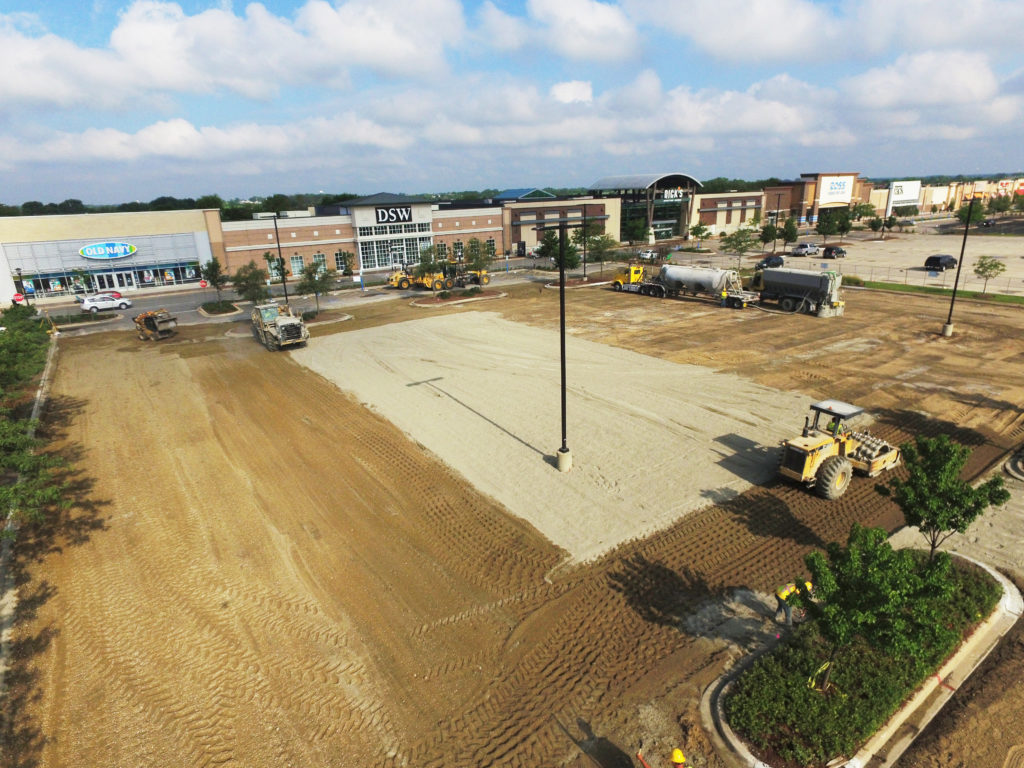
What do we make stable, steadfast, or firm?  Sub-grades. Sub-grades are the top soil layer below pavements or building slabs that support aggregate base.  We mostly stabilize soils in 12” to 16” lifts using cement or fly ash.  When performing stabilization we aim to achieve a strength gain that can be measured.  The verified strength can be utilized in the structural design of pavement and building slab cross sections that are supported by stabilized sub-grade .

stabilization & modification

Soil Modification

Remember the definition?  It’s the making of a limited change in something.  The something we want to change is soil.  When we modify soil we most often change it by drying it.  Very often, excavators need to utilize fill from their jobsite that is too wet to compact.  We use the same process and many of the same products that we use in stabilization, but the most popular to modify soil are lime kiln dust and quicklime.  The main goal for modification is to dry the soil to a moisture level that allows compaction to be completed properly.  Modification can be performed in a single lift, to help pass a proof roll, or in multiple lifts to build a site’s building pad or parking lot.

stabilization & modification

Soil Stabilization

Improved Construction Schedule – Make your sub-grade rain resistant; the stabilized soil will remain strong through rain events and can be worked on soon after they occur.

Better Value – Reduce the thickness of aggregate, asphalt, or concrete needed to meet structural design requirements, and reduce your cost.

Soil Modification

Improved Construction Schedule – Modification is faster and more reliable than disking and drying on projects with tight deadlines.

Better Value – Cheaper, faster, stronger, and better for the environment than export of unsuitable soil, and import of quality fill to build your site.

umbrella

Protection from Future

Moisture

engineered

Engineered to Specific

Structural Requirements

time-savings-icon

30-80%

Time Savings

money-saved

40-80%

Cost Savings

JOIN OUR ELIST

Get the latest news and educational articles delivered right to your inbox. Join the Rock Solid elist today!

Name*

Want to Learn More?

Visit RoadResource.org and check out their Treatment Resource Center on Soil Stabilization & Soil Modification.

Or Contact Us.  We Love to Talk Soil Improvement.

Written By:

MikeBlog

A Case for Modification Contingency on Earth Day

Googling "Undercut"

Google the word “undercut”. You will find stories on companies undercutting one another to grab more market share, or corrupt politicians undercutting one another to gain influence.  Undercuts are bad for business.  Believe me, I have monitored the word “undercut” on my Google Alerts for several years, and it’s all bad.

Why do we Undercut?

As contractors, the idea that we do not understand the sub-surface condition of our projects is scary. Even if we have soil borings, those borings are only representative of their exact location.  In a competitive bid climate, we must keep prices low, so we quote the best-case scenario and include an insurance policy called an undercut contingency.  Undercuts are expensive, and place a heavy burden on the environment.

These contingencies often include enough dollars to cover removing and replacing a small section of the entire buildable area, or worse, they provide a unit price that is open ended.  When poor soils are encountered, the contingencies are quickly exhausted or escalate out of control and leave us with an unhappy owner.

Is There Another Way?

On Earth Day, let us consider some better ways for our industry and our planet.

Try a site guarantee and provide a lump sum price for site development that includes a calculated risk to modify poor soils when necessary. The owner gets a guaranteed price, and you, the experienced contractor, takes the risk.  When things work out you get a little reward for the risk, and your customer sleeps easy knowing their project budget is secure.

If you do not want to take all the risk, consider a modification contingency.  Rather than funding undercuts for a small portion of the project, consider earmarking the same dollars for modifying one lift of the entire buildable area.  Typically, the cost would be comparable to undercutting 25% of the same area, and if needed, leave the owner with a stronger more consistent subgrade. In this scenario, there is little risk of the owner exhausting the modification contingency and running over budget.

Another solution, a win-win, for both the owner and the contractor is for the contractor to buy the site with a modification contingency credit.  With this method, the contractor buy’s the site but offers a credit for


modification not performed.  Less risk for both parties, and the owner has a budget that can only shrink.

On Earth Day, make it a point to stop undercutting your customers and our planet.  Do the right thing for your projects and start including modification contingencies in your contracts.

Need help creating a modification contingency plan?  Give us a call.

Earth Day

JOIN OUR ELIST

Get the latest news and educational articles delivered right to your inbox. Join the Rock Solid elist today!

Name*

Need Help? Give Us a Call Today.

Need help creating a modification contingency plan?  Contact us today.

Written By:

MikeBlog

Rock Solid Nominates Two ARRA Award Winners

Each year ARRA recognizes various public officials and consulting engineers for their use of recycling and reclaiming techniques on their projects. Nominations for these awards are submitted by various ARRA members and chosen at the ARRA Special Recognition Awards.

The month of February not only brought us the GLCA Safety Award. But we were able, with the help of ARRA, to honor and recognize two different Counties in two different states for their use of Soil Stabilization and Full Depth Reclamation to help them save time and money.

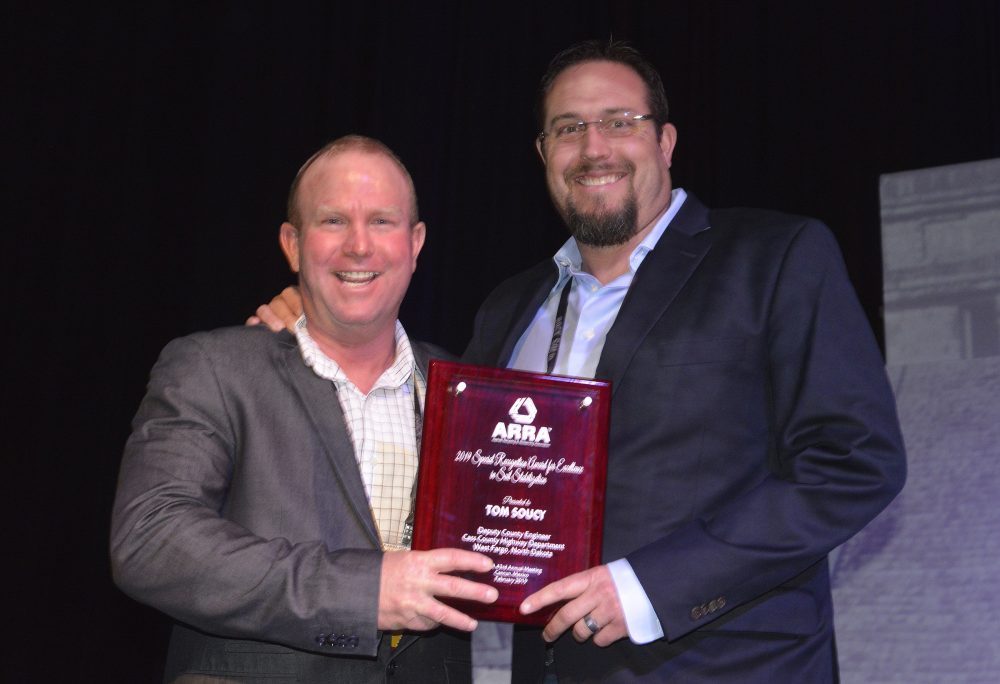
The 2019 ARRA Award for Excellence in Soil Stabilization went to Tom Saucy, Deputy County Engineer for the Cass County, ND Highway Department for his work with Rock Solid’s President and current ARRA Vice President, Jonathan Pease, on the ARRA Regional Seminars in North Dakota. Tom has been the driving force behind making sure Soil Stabilization keeps advancing through their specifications every year throughout the Midwest.

ARRA Award
*Pictured is Jonathan Pease receiving the Award for Excellence in Soil Stabilization on Tom Saucy’s behalf, from past ARRA President, Darren Coughlin

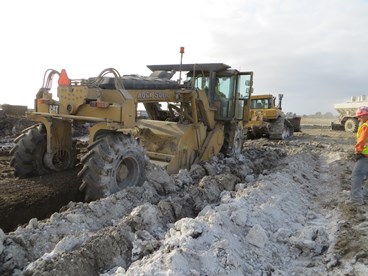
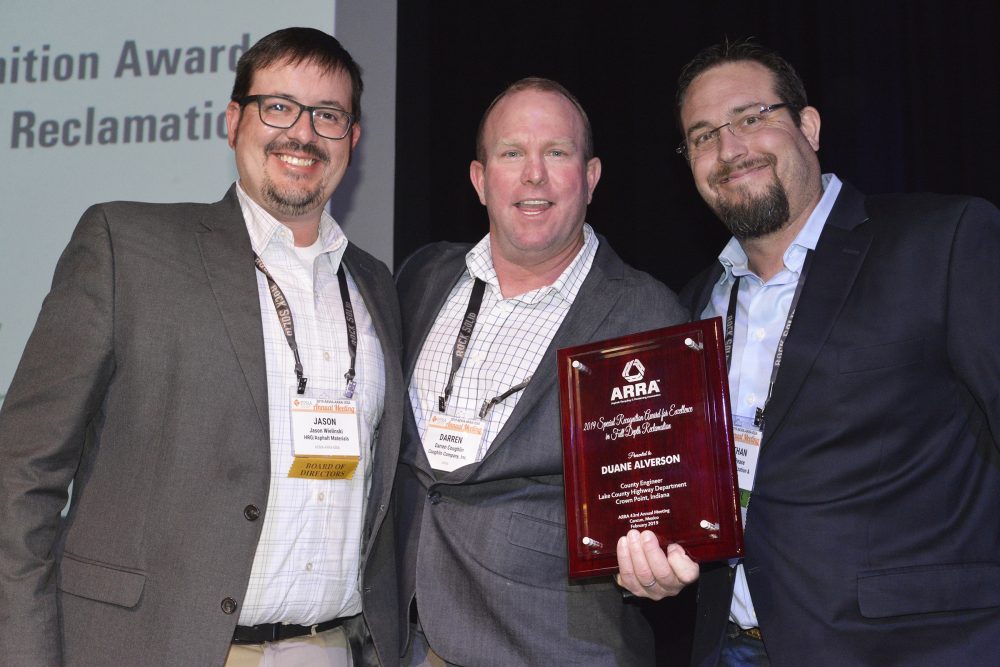
Duane Alverson, County Engineer for Lake County, IN  won the 2019 ARRA Award for Excellence in Full Depth Reclamation. Duane and his team have been implementing FDR techniques in Lake County for several years after attending an LTAP conference and seeing a presentation on FDR.  For 2018, Lake County designed a project to repair a 3.2 mile stretch of Clay St. The Clay Street Project was over 45,000 square yards of asphalt and aggregate base. Our team at Rock Solid was able to go in and perform Full Depth Reclamation with emulsified asphalt and complete the project in under a weeks’ time all while salvaging over 12,000 tons of asphalt & aggregate.

ARRA Award Full
*Pictured is Jonathan Pease receiving the Award for Excellence in Full Depth Reclamation on behalf of Duane Alverson, from past ARRA President, Darren Coughlin

JOIN OUR ELIST

Get the latest news and educational articles delivered right to your inbox. Join the Rock Solid elist today!

Name*

Written By:

Mike.EricBlog

FDR with Emulsified Asphalt

Check out this quick video of Rock Solid Stabilization direct injecting 1.7 gallons of asphalt emulsion per SY with one of our Wirtgen WR 250i Reclaimers.  The 3.2 mile Full Depth Reclamation project on Clay Street is part of Lake County, Indiana’s 2018 road preservation plan.  Mix designs from, trusted industry experts, Midland Standard Engineering & Testing, Inc. determined the addition of 2.5% of emulsified asphalt to the top 6” of pre-pulverized asphalt and aggregate base would meet the design strength requirements set forth in INDOT ITM 594-17.

Customization of emulsified asphalt stabilizing agents binding RAP and aggregate base is vital to meeting specific project strength and curing criteria.  We turned to Tri-State Asphalt, LLC for their expertise in pavement preservation.  They provided and delivered the engineered asphalt emulsion that helped Rock Solid Stabilization complete the 45,484 SY project in a little over 3 days.

Written by:

MikeBlog

JOIN OUR ELIST

Get the latest news and educational articles delivered right to your inbox. Join the Rock Solid elist today!

Name*

Stabilization with Direct Water Injection

Top 5 Reasons to use Direct Water Injection when  Stabilizing Soil

  1. Uniform Consistency — Direct Injection controls the precise application of water accurately to the exact percentage needed for the stabilized cross section to reach optimum moisture.
  2.  Gravity — Water runs downhill and puddles in low spots, so when “top dressing” or applying water through a spray bar there is no guarantee the cross section is receiving the same application of water for the stabilized area.
  3. Adjust for Overlap — Direct injection capabilities allow for the operator to control the width of the application area by activating or restricting water nozzles. (A remaining 4’ section can effectively receive the water without over hydrating the previously stabilized adjacent area)
  4. Adapt to Changing Ground Conditions — Direct injection capabilities allow the operator to quickly adjust the amount of water applied to reach optimum moisture for the stabilized section. Project soils rarely retain the same moisture content or makeup throughout a site, so it’s important to be able to adjust for these different ground conditions.
  5. Better Results & Strengths — When proper moisture is applied consistently the stabilized cross section is better controlled, more uniform, and stronger.

It’s not always possible to use direct injection, but when it is, it is the best way to add moisture to your stabilized section.  It’s the Rock Solid Way!

Contact Us to Learn More

Written by:

MikeBlog

JOIN OUR ELIST

Get the latest news and educational articles delivered right to your inbox. Join the Rock Solid elist today!

Name*

The City of Portage begins $2 million road rehabilitation project utilizing Full Depth Reclamation

It’s been known for a long time that utilizing Aggregate Base Stabilization and Full Depth Reclamation techniques showcase the best in-place pavement recycling has to offer by saving money, saving time, improving strength, and reducing the need for non-renewable aggregates.

Check out this article, Portage begins $2 million street rebuilding project throughout city to see why the City of Portage implemented the most cost efficient and environmentally friendly approach to repairing their streets.

Re-use The Existing Aggregate

Preliminary estimates, based on project quantities, reveal the City of Portage eliminated the removal of over 2,200 tons of existing aggregate base.  That is over 100 semi loads of aggregate that will be stabilized in place, with cement, rather than hauled offsite.  You can double those numbers since you no longer need to haul in new aggregate base.  The benefits in terms of dollars, scheduling, and environmental impact makes considering Full Depth Reclamation or Base Stabilization very smart for any road rehabilitation project.

Smart Road Managers Choose Full Depth Reclamation

When road managers choose to fully remove and replace their roads they typically spend more money per lane mile, extend their construction timeline exponentially, and nearly double the amount of non-renewable aggregates needed to rebuild their road.  There is no doubt the City of Portage made the smart choice for their tax payers and the environment.  We, at Rock Solid, are excited to be working on this intelligently designed project for Rieth-Riley and the City of Portage, IN.

Written by:

MikeBlog

Name*