WHAT IS FULL DEPTH RECLAMATION AND HOW IS IT PERFORMED?

Ensuring roads and other paved surfaces remain in good condition is crucial for protecting public safety and providing essential infrastructure. However, the traditional methods used to replace deteriorated asphalt can be costly, time consuming, and wasteful. These issues are magnified when you consider how many miles of road and parking lots need to be restored on a regular basis due to simple wear and tear. Removing and replacing pavement and it’s underlying aggregate base entirely used to be the only way to remediate worn-out roads, but today there is another option that is far more expedient, affordable, and ecofriendly — full depth reclamation (FDR).

UNDERSTANDING THE PROCESS OF FDR

What is full depth reclamation? In simple terms, it involves reusing the existing asphalt road aggregate base material to create a stronger, more stable surface. There are four main steps to the process:

  • Pulverizing the existing pavement — The asphalt is pulverized with a road reclaimer, converting it into a usable aggregate base that can be reused in-place to revitalize the road .
  • Stabilizing the base — Additives are used to increase the strength and durability of the original materials that have been pulverized into a well blended aggregate base.
  • Shaping the material — The reclaimed & now stabilized materials are shaped and compacted to create a smooth, stable surface for the restored roadway.
  • Application of wearing course — Thin surface overlays like a micro-surface, chip seal, or thin HMA surface protects the restored pavement and gives it added stability.

There are three main techniques typically used for FDR projects, which vary based on the additives used to stabilize the base:

  • Mechanical — Aggregate materials are mixed into the pulverized asphalt & aggregate base .
  • Bituminous — This technique involves mixing liquid emulsions into the pulverized asphalt & aggregate base .
  • Chemical — Lime, fly ash, or cement are utilized to strengthen and stabilize the existing pulverized asphalt & aggregate base materials.

THE BENEFITS OF FULL DEPTH RECLAMATION

The traditional remove-and-replace approach to road reconstruction was more or less the only one for a long time, but not necessarily because it offered many advantages. This process tended to be a drawn-out one, with projects requiring a week or longer to complete under most circumstances. It also called for hundreds — sometimes thousands — of truckloads of material to be hauled to and from the site, racking up significant fuel costs and contributing a lot of carbon emissions into the atmosphere.

Using FDR eliminates these issues, because the existing material is  pulverized in place,  remains on the ground, and is ready for stabilization immediately, there’s no need to transport large quantities of materials to and from the site. This also cuts down on the amount of time the project requires by an average of 55%  in most cases. Not only does the process result in lower emissions from trucks, but also recycling the existing material means fewer resources are consumed. This makes FDR a more environmentally sustainable process overall. The resulting pavement also has greater durability, able to hold its structural integrity for a longer period of time.

CONTACT ROCK SOLID TODAY

Rock Solid Stabilization & Reclamation, Inc., is the leader in providing full depth reclamation services for contractors, developers, and governmental entities across the country. We’ve completed countless successful projects, such as this one in Orland Park, Illinois. To learn more about everything we have to offer, reach out and speak with one of our representatives today.

Those in the business of building roads and highways have a lot of heavy equipment at their disposal. Graders, compactors and excavators are some of the most imposing and impressive machines used for road construction and reclamation. However, as important as they are, one of the most versatile and essential tools used on the jobsite may also be one of the least assuming. It’s a simple chemical compound that comes in the form of tiny flakes, small pellets or as a liquid. Knowing how to apply calcium chloride for dust control and road stabilization is one of the most necessary factors for ensuring the success of a project.

Why Calcium Chloride Matters for Road Construction Projects

It’s no secret to anyone in the road construction business that their work involves a lot of dust and dirt. Machinery working on bare earth can end up kicking a lot of fine particulates into the air. This does more than create a mess, as excessive dust can lead to many long-term issues that impact projects. For example, there’s the potential health risks created by workers and those around the project breathing in contaminants in the air. Any dust that is carried by the wind and settles in other places can lead to environmental impacts such as polluted water sources, which can affect the project’s sustainability and even lead to violations of local environmental regulations. Contractors also should take care to prevent dust because of the harm it can do to their equipment. Fine dust particles can build up inside machinery and cause performance issues as well as breakdowns if not properly addressed.

On top of all these concerns, the erosion of soil through typical construction activities also can have an impact on the overall stability of the completed roadway. It’s for these reasons that many contractors choose to employ calcium chloride to help prevent dust and stabilize the ground underneath their work.

How Calcium Chloride Works

The application of calcium chloride for road stabilization and dust control is common because of its ability to stabilize aggregate. It accomplishes this thanks to three key properties. It is hygroscopic, which means it naturally absorbs moisture out of its surroundings. Once it does, it dissolves into the water to form a clear solution that is deliquescent, meaning it resists evaporation. This resulting solution has a high degree of surface tension, which helps it lubricate the underlying aggregate and improves each particle’s ability to interlock with those around it.

Thanks to its ability to resist evaporating, using calcium chloride for dust control and stabilization means the road base retains an optimal level of moisture. This offers a number of benefits for construction and reclamation projects, especially compared to traditional methods.

The Benefits of Calcium Chloride Road Treatment

Using calcium chloride for road dust control is highly effective because it won’t evaporate as quickly even under direct sunlight and in extreme heat. It serves to keep the road’s surface damp in almost any conditions, ensuring good visibility for drivers and helping to keep the road in optimal condition for as long as possible. Although pure water has been used traditionally for this purpose, the fact that it evaporates so quickly means it must be applied multiple times. This can become an expensive proposition in many environments.

In terms of road stabilization, any dust that is kicked up by traffic runs the risk of resettling wherever the wind takes it. Over time, this means there may be fewer fine particles helping to hold the larger aggregates in place. This can lead to potentially serious stability issues and premature deterioration of the pavement. Calcium chloride helps prevent this by holding the fine dust and other aggregate materials together.

Comparing Calcium Chloride to Other Dust Control Agents

Calcium chloride is far from the only chemical agent used for dust suppression and soil stabilization. Contractors have a range of options that offer their own unique pros and cons, including:

  • Magnesium chloride: Like calcium chloride, magnesium chloride draws water out of soil to prevent dust. It also tends to be less expensive upfront, but the fact that it dries out faster means more applications may be necessary than with calcium chloride.
  • Lignosulfonates: Made from trees, lignosulfonates are organic binders that can hold soils together. Although this means it presents many ecological benefits, it can become slick when wet and may require more applications to be as effective as calcium chloride.
  • Synthetic polymers: Adding a layer of synthetic polymer creates a kind of crust that prevents dust from being lifted into the air. This performance tends to come at a much higher price than using calcium chloride, however.

Application Methods and Best Practices

Calcium chloride typically is deployed in road construction either in liquid solution form or as solid pellets or flakes. When sprayed directly onto the surface of the subgrade, it can serve to suppress dust as well as strengthen the soil. For applications that require additional stability, such as when soils are especially loose or wet, the solid forms of calcium chloride may need to be mixed into the earth during the grading process.

In most cases, it’s recommended that crews perform compaction after applying calcium chloride to ensure the proper density for the resulting subgrade. Grading the surface to facilitate drainage also is necessary, as excessive moisture will dilute the calcium chloride and impact its performance.

Performance Factors and Environmental Conditions

The efficacy of calcium chloride for dust suppression and soil stabilization can be influenced by several external factors, such as:

  • Humidity: Excessively dry conditions can hurt the performance of calcium chloride solutions, and may require applications of water or rainfall to reactivate them.
  • Temperature: Higher temperatures can accelerate the rate at which calcium chloride absorbs moisture.
  • Traffic: The heavier the traffic on the road, the harder calcium chloride has to work to control dust.

When used for dust suppression, calcium chloride typically should be reapplied after prolonged periods of dry weather. Roads that experience heavy traffic also should reapply liquid calcium chloride on a more-frequent basis than quieter roads.

Safety and Handling Tips

In its solid form, calcium chloride must be stored in sealed containers in a cool, dry place to prevent it from clumping. When handling it, workers should be equipped with PPE including gloves, respirators, and safety goggles to prevent direct exposure to skin and eyes. This will prevent irritation. Workers who handle calcium chloride also should wash their hands thoroughly after each use.

Call Rock Solid for Complete Expertise

The use of calcium chloride to keep dust down and stabilize the road base is a great choice whenever you want a long-lasting, easy-to-apply solution. Rock Solid Stabilization & Reclamation is a leader in providing this and other related services to strengthen road construction through base stabilization and full-depth reclamation projects. We work closely with your crew no matter where you’re working to ensure the best overall results for you. To learn more about this and any other capabilities we can offer to you, reach out and get in touch with us today.


Retail Grocery / Naperville, IL

THE CHALLENGE:

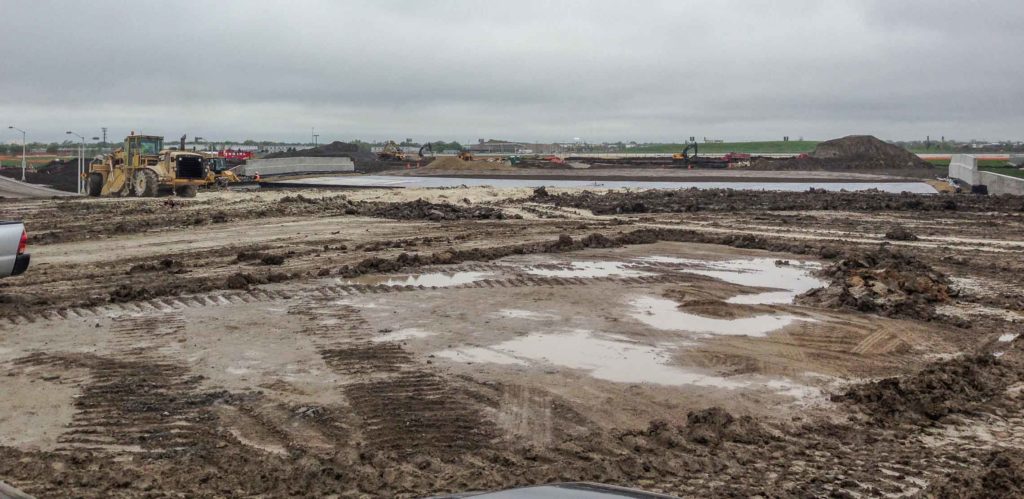
Builtech, LLC received 6 inches of rain in 7 days in late October.

With Winter nearing and the asphalt plants shutting down for the year

Builtech had to act fast to dry their site to keep their project delivery date on schedule.

THE SOLUTION:

They needed Soil Stabilization with Portland Cement to guarantee their project stayed on schedule.

Multiple lifts, totaling over 17,000 SYs treated with 445 tons of Portland Cement in 3 short days did the trick.

By drying and strengthening each lift to meet compaction, Builtech was able to place their asphalt by late November, avoiding costly delays.

We want to recognize Builtech, LLC for choosing to build smarter, build faster, & build better.

Project Heartland / Morris, IL

The Problem:

Alston Construction and Witech Excavating needed to expedite Project Heartland to guarantee their building pad would be completed before winter. Wet fill and cooler temperatures put their project schedule at risk.

The Solution:

Using Soil modification with quick lime, dried the wet fill to meet compaction requirements.

Capping the building pad with cement stabilization, protects it from Old Man Winter.

In 19 days over 520,000 SYs of wet fill were treated with quick lime (that’s over 27,000 SY’s per day)

In 6 short days the building pad was cement stabilized to beat the schedule (that’s 25,000 SY’s per day)

We want to recognize Alston Construction and Witech Company for choosing to build smarter, build faster, & build better.

Naperville Streets 2019

Andy Hynes, Deputy City Engineer on the Brush Hill Project was just one of the many employees within the engineering department at the City of Naperville. Andy has helped advance the use of Full Depth Reclamation on Naperville streets over the past 4 years to help repair their cities failing asphalt roads.

The city of Naperville started using FDR in 2015 when they came across an emergency that needed to be fixed right away. Once they removed the existing asphalt pavement in a cul-de-sac, they saw the aggregate base needed some extensive repairs. Their time was limited so they knew doing a full reconstruction was not an option. After talking with their peers and the contractor they decided to try Full Depth Reclamation. Now, 4 years later they are using this process to reclaim a number of neighborhood and city streets throughout Naperville.

One of the three Full Depth Reclamation projects they performed in 2019 was the Brush Hill Project. This project covered just under a mile of neighborhood roads, equating to ~14,000 SY’s. By implementing FDR with Cement, The City of Naperville not only cuts their costs in half as compared to full depth removal and replacement but cuts their construction timeline even more. In summary, they are getting a stronger road, at half the cost, in less than half the time.

The city of Naperville, since 2015, has completed ~378,000 square yards of FDR (~59,000 square yards of that coming in 2019) and recycled over 245,000 tons of aggregate base.

“The process has, overall, been beneficial. Less impact on the residence, as they are not out of their driveways for a couple weeks at a time (as compared to full reconstruction). On top of that you also have cost savings, so there are a lot of advantages to FDR.” – Andy Hynes, City of Naperville.

Written By:

What is Quicklime?

Quicklime is formed by burning or heating naturally occurring limestone rock.

Used in the steel industry, it acts as a flux in purifying steel removing all phosphorus, sulfur, and silica, which are all damaging to your health.

Quicklime is also used for water treatment. Since it is an alkaline, it is used to adjust the pH levels of drinking water, lowering the acidity to make water potable.

In the site work industry, quicklime is used for soil modification to dry and strengthen soils with a high plasticity rating such as fatty clay.

Quicklime in Modification and "dry down"

Soil Modification @ Subgrade: When the jobsites subgrade is failing a proof roll due to being above optimum moisture, adding quicklime will quickly dry and increase stability. Not to mention the cost to modify can be up to 80% cheaper and 50% faster vs. the cost of undercutting.

“Dry Drown” Your Fills (lifts): Often modification is referred to as “dry down”.  Instead of discing, drying, and hoping for wind and sunshine, blending quicklime will dry wet material in hours rather than days. Quicklime dry down is a great way to keep a project on schedule and protected from future rain events.  Gambling with Mother Nature could cost more than a few days.

Quicklime is cost effective, and available throughout the nation, making quicklime a great solution for drying wet soils.

JOIN OUR ELIST

Get the latest news and educational articles delivered right to your inbox. Join the Rock Solid elist today!

Name*

Have Questions?

Written By:

Eric.MikeBlog

JOIN OUR ELIST

Get the latest news and educational articles delivered right to your inbox. Join the Rock Solid elist today!

Name*

What is Fly Ash?

Fly ash is a byproduct from burning coal which makes steam to generate electricity.  When burning coal, combustion particles rise out of the combustion chamber with flue gasses. They are captured in filters to prevent them from reaching the atmosphere and collected for disposal or beneficial reuse. These particles are called fly ash.

There are two types of fly ash, Class C and Class F. Class C is self-cementing fly ash and is used in the production of concrete as a substitute for Portland Cement, and as a chemical stabilizing & modifying agent to dry and/or strengthen poor soils. Class F has very little self-cementing properties, but can be combined with additives such as quicklime, hydrated lime, or cement (portland or hydraulic) to create cementitious compounds for the same purposes.

How Fly Ash Improves Soil Properties

When mixed with soil and other additives, fly ash enhances the ground’s physical properties. For example, it adds shear and compressive strength that helps hold the soil in place even when the roadway on top of it is subjected to extreme forces. This also provides the earth with greater capacity for bearing heavy loads. Fly ash also serves to reduce soil plasticity and shrink-swell potential, which helps prevent sinking or buckling that can lead to damaged pavement. The addition of fly ash to soil also serves to prevent it from absorbing moisture that can lead to instability.

This is why the use of this additive is often recommended for projects in areas with expansive or clay-heavy soils. The process is employed most frequently when building subgrades for roads, parking lots, industrial pads, and embankments where strength and stability are essential.

Rock Solid’s Fly Ash Stabilization Process

Rock Solid uses a proven method for fly ash stabilization that provides optimal results. We begin with extensive soil testing to determine its properties, which is used to determine the proportions of fly ash and water needed. This is also when we determine whether any more additives will be required. Then we get to work mixing the additives into the soil and compacting the earth to ensure the best performance from the resulting subgrade. After the curing process is completed, we conduct quality control tests to make sure our work has achieved the desired results and meets regulatory compliance standards.

Fly Ash in Modification, Stabilization and FDR

The properties of fly ash make it a popular choice for use in soil modification and stabilization techniques:

Soil Modification: Given its cementitious properties, fly ash can dry down wet soils and increase the strength of each fill layer. It works best in sandy/silty soils but can be very effective in lean clays as well.

Lime Kiln Dust

Soil & Base Stabilization: Using fly ash in soil stabilization applications to strengthen the top 8”-14” of subgrade can decrease the thickness of aggregate base and/or pavement (asphalt or concrete) needed to achieve the structural design strength of the overall pavement section. Again, it works best in sandy, silty soils, but is also a great option to stabilize existing aggregate base when performing parking lot repairs or upgrades.

Lime Kild Dust

Full Depth Reclamation: Depending on the existing make-up of the current pavement & aggregate base, fly ash can be used by itself, or in combination with other additives, to rehabilitate entire pavement sections in place.

Fly ash yields less strength gain than Portland Cement. Typically, you need to use twice as much product to achieve similar results when compared to cement.  However, if a fly ash source is within proximity of a project, utilizing it could be a better value and is worth comparing.

JOIN OUR ELIST

Get the latest news and educational articles delivered right to your inbox. Join the Rock Solid elist today!

Name*

Have Questions?

Written By:

Mike.EricBlog

What is Lime Kiln Dust (LKD)?

Lime Kiln Dust, a.k.a LKD, is a byproduct created when manufacturing Quicklime. When limestone is naturally heated, it produces gas with dust. The dust that is screened out is called Lime Kiln Dust.  LKD, has little beneficial use, and is mostly disposed of into landfills. The site work industry uses LKD as a stabilizing agent to dry poor soils.

LKD in Modification, Stabilization and FDR

Soil Modification: Blending LKD into wet fill, often referred to as “Dry Down” can keep projects on time and on budget.  Dry Down is one of the most common uses for LKD.  It is very good at removing moisture from fill materials, so compaction can be achieved faster allowing for another lift of fill to be placed.

Lime Kiln Dust

Soil Stabilization: Lime kiln dust for soil stabilization can stabilize building pad or parking lot sub-grades when existing soils are mostly comprised of clay like materials.  The increase in strength can be used to offset the thickness of aggregate base or surface (slab or pavement) needed to meet the engineers structural design.  This offset can provide big value.  See our NIMC case study to learn more. Using quicklime for soil stabilization also can help reduce the plasticity of the soil and make it easier to work.

Lime Kild Dust

Full Depth Reclamation: LKD can be used as an additive in combination with bituminous stabilizing agents to increase strength when repairing reclaimed materials with higher clay content.  Click HERE to learn more.

The Difference Between LKD & Quicklime

Although they come from the same general source, lime kiln dust and quicklime have different chemical compositions. Comprised mainly of calcium carbonate and magnesium carbonate, LKD has a higher proportion of unreacted minerals and less available calcium oxide. This is because it is produced when limestone is heated at relatively lower temperatures. On the other hand, quicklime is created when limestone is heated at temperatures above 900 degrees Celsius. It is highly reactive, interacting with water to generate heat and calcium hydroxide. This makes it useful in a wide range of industrial applications.

Since quicklime has more available calcium oxide you can use less of it to modify the same square footage of your project. In most cases, quicklime can be used at half the application rate of LKD.

CONTACT ROCK SOLID TODAY

Using LKD and quicklime for soil stabilization can help you achieve long-lasting, superior results. Each can be used in similar soil types such as clay, fatty clay, silty clays, etc. and it is very rare that one product would work better than the other in the same soil conditions.

Rock Solid Stabilization & Reclamation has the experience and expertise in using these additives to ensure your project goes as smoothly as possible. When you choose to work with us, you’ll gain a true partner who works closely with you to deliver a successful project each time. If you’re ready to learn more about our full capabilities, reach out and speak with one of our helpful representatives today.

JOIN OUR ELIST

Get the latest news and educational articles delivered right to your inbox. Join the Rock Solid elist today!

Name*

Have Questions?

Written By:

Eric.MikeBlog

What is Quicklime?

Quicklime is formed by burning or heating naturally occurring limestone rock.

Used in the steel industry, it acts as a flux in purifying steel removing all phosphorus, sulfur, and silica, which are all damaging to your health.

Quicklime is also used for water treatment. Since it is an alkaline, it is used to adjust the pH levels of drinking water, lowering the acidity to make water potable.

In the site work industry, quicklime is used for soil modification to dry and strengthen soils with a high plasticity rating such as fatty clay.

Quicklime in Modification and "dry down"

Soil Modification @ Subgrade: When the jobsites subgrade is failing a proof roll due to being above optimum moisture, adding quicklime will quickly dry and increase stability. Not to mention the cost to modify can be up to 80% cheaper and 50% faster vs. the cost of undercutting.

“Dry Drown” Your Fills (lifts): Often modification is referred to as “dry down”.  Instead of discing, drying, and hoping for wind and sunshine, blending quicklime will dry wet material in hours rather than days. Quicklime dry down is a great way to keep a project on schedule and protected from future rain events.  Gambling with Mother Nature could cost more than a few days.

Quicklime is cost effective, and available throughout the nation, making quicklime a great solution for drying wet soils.

JOIN OUR ELIST

Get the latest news and educational articles delivered right to your inbox. Join the Rock Solid elist today!

Name*

Have Questions?

Written By:

Eric.MikeBlog

WHAT IS CEMENT?

According to cement.org, Cement powder is manufactured through a closely controlled chemical combination of calcium, silicon, aluminum, iron and other ingredients. More commonly, it is one of the basic ingredients of concrete when combined with sand, rock, and water. Cement and water combine to make the paste that binds the sand and rock together to produce concrete.

CEMENT IN FDR AND STABILIZATION

Full Depth Reclamation. Blending cement into the pre-pulverized homogenous mixture of asphalt, aggregate base and subgrade strengthens the entire treated section without removing your existing road or parking lot assets (aggregate base and asphalt).

Base Stabilization. Similar to FDR (also referred to as Cement Treated Base), cement can be added to existing aggregate base after asphalt is milled and removed to dry and strengthen your aggregate base layer prior to new pavement installation.

Subgrade Stabilization. If your silty and sandy sub-grade is too wet to compact and pass a proof roll, you can blend cement to reduce the moisture, re-compact, and pass your proof roll.

Soil Stabilization. On wind farms, it doesn’t pay to build your traditional 12” aggregate road for temporary construction access to the turbine site. By using cement to strengthen the top 8”-14” of soil you eliminate the need for deeper excavation, geogrids, and reduce the quantity of aggregate needed to build your road.

Cement in FDR and Stabilization

TYPES OF CEMENT

Portland Cement, Soil Cement, and Cement Slag can be used as chemical stabilizers for Soil Stabilization, Sub-grade Stabilization, Base Stabilization, or Full Depth Reclamation. Cement is one of the most versatile and readily available stabilizing materials in the nation, and plays a vital role in supporting our nations infrastructure responsibly.

JOIN OUR ELIST

Get the latest news and educational articles delivered right to your inbox. Join the Rock Solid elist today!

Name*

Give us a call today, or Contact Us below…

Written By:

Mike.EricBlog